
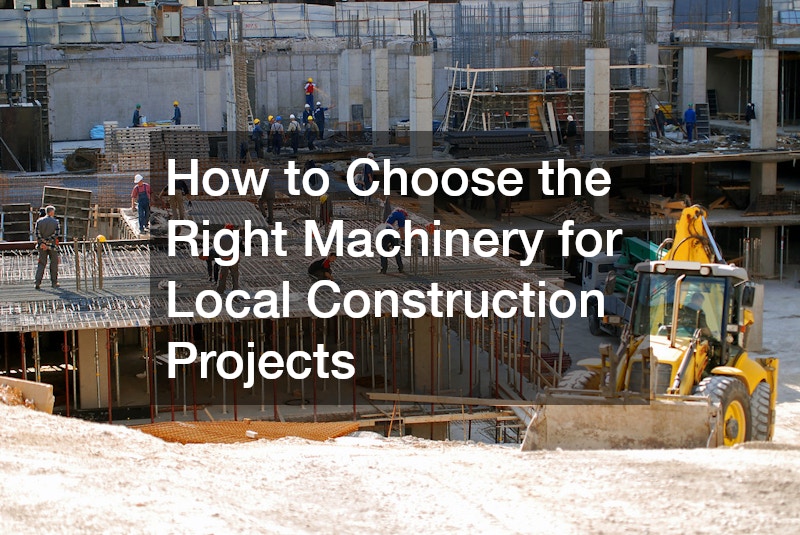
Imagine breaking ground on a highly anticipated commercial build situated on a tight, compact urban lot. The project is already on a strict timeline, and the budget leaves little room for contingencies. On day one, a massive, oversized earthmover arrives on site. Within hours, the sheer size of the machine becomes a liability. It cannot safely maneuver between the existing structures, its swing radius threatens neighboring properties, and its excessive weight damages the newly poured concrete access apron. The project grinds to a halt, incurring immediate financial penalties, wasted daily rental fees, and severe logistical headaches as the site manager scrambles to replace the inappropriate machine.
This scenario is far too common in the construction industry. The process of choosing the right machinery for local construction projects is not merely a matter of ticking boxes on a rental sheet or grabbing whatever equipment happens to be available in the yard. Machinery selection is the absolute backbone of a successful build. It dictates the pace of the schedule, fundamentally impacts labor costs, and most importantly, establishes the baseline for site safety. When you deploy the correct equipment, you amplify the capabilities of your workforce, protect your materials from damage, and maintain a seamless flow of operations from groundbreaking to the final architectural touches.
Unfortunately, many contractors approach machinery selection with a “bigger is better” mentality, assuming that maximum horsepower equates to maximum efficiency. In reality, choosing the right equipment requires a systematic, granular analysis of the project site. You must meticulously evaluate the unique topography of the land, the precise load capacities required for the materials you will handle, and the logistical constraints of the surrounding neighborhood.
This comprehensive guide is designed to navigate the complexities of equipment selection. By breaking down the essential phases of a build—from initial ground preparation and heavy material transport to complex overhead lifting and delivery logistics—you will learn how to audit your site effectively. We will explore how to assess ground conditions to prevent machinery from bogging down, how to calculate accurate payloads to avoid catastrophic equipment failures, and how to manage the intricate logistics of moving massive vehicles through local streets. Armed with this knowledge, you can ensure your next construction project is equipped for safety, efficiency, and ultimate success.
Map Out Your Earthmoving and Trenching Needs
Before any vertical construction can begin, the site must be properly graded, trenched, and prepared. Earthmoving is often the most physically demanding phase of a project, and selecting the right machinery for this task requires evaluating the specific soil type, the required dig depth, and the overall footprint of the site. A failure to match the machine to the terrain can result in equipment becoming hopelessly bogged down in mud, or worse, triggering a trench collapse due to excessive ground pressure near an unstable edge.
Analyzing site space constraints is the first critical step. The physical dimensions of the local site strictly dictate the size and style of the machine you can deploy. If you are working on a sprawling, open commercial lot, a standard large-scale tracked earthmover will offer the power and capacity needed to move massive volumes of soil quickly. However, if the project is nestled in a dense residential neighborhood or a cramped urban alleyway, deploying a massive machine is a recipe for property damage. In these confined spaces, you must specify zero-tail-swing machines. These specialized units are designed so that the rear of the rotating upper structure never extends beyond the width of the tracks, allowing operators to work flush against walls, fences, and adjacent buildings without the risk of the counterweight swinging into a neighboring structure.
Determining the required dig depth and breakout force is equally important. Breakout force refers to the maximum power the machine can exert at the bucket’s teeth to tear through the earth. You must provide actionable parameters by matching the machine’s arm length and hydraulic power to your specific project needs. If you are digging shallow utility trenches for electrical conduits, a compact machine with a standard arm is sufficient. However, if you are excavating a deep basement or digging foundation footings in heavily compacted, rocky clay, you will need a machine with enhanced hydraulic flow and a longer stick length to reach the required depths without destabilizing the trench walls.
When sourcing the right tracked or wheeled machines for these tasks, flexibility is often a contractor’s best asset. For many local builders, taking advantage of excavator rentals makes the most financial sense for short-term earthmoving phases. Renting allows you to specifically tailor the machine’s size and attachments—such as swapping a standard bucket for a hydraulic breaker or a grading blade—to the exact demands of the week’s schedule without taking on the massive capital expenditure of purchasing the asset outright.
Furthermore, there are times when the site conditions are simply too complex or hazardous to manage with your own crew. When dealing with exceptionally rocky soil that requires blasting, deep basement excavations requiring intricate shoring, or projects governed by strict local municipal codes regarding groundwater runoff, the risk profile changes. In these high-stakes scenarios, partnering for complex groundwork is the smartest operational choice. It often makes sense to step back and outsource the digging entirely to a professional excavating company whose crews specialize exclusively in managing volatile soil mechanics, ensuring the foundation of your project is handled with precision and compliance.
Calculate Payload and Material Movement Capacities

Once the groundwork is laid, the project shifts to the continuous, daily movement of heavy materials. From the moment delivery trucks begin dropping off supplies, you need a reliable method for transporting those materials from the laydown yard to the active installation zones. Matching your palletized material weights and the specific terrain type to the correct lifting vehicles is essential to ensure safe, efficient transport across the site. Using an underpowered machine to lift an overweight load is a direct path to a tipping incident, which can destroy expensive materials and severely injure personnel.
Auditing material weights requires precision. You cannot rely on visual estimations when dealing with industrial building supplies. You must calculate the heaviest single pallet or bundle that will need to be moved at any given time.
Key Considerations for Auditing Material Weights:
-
Static vs. Dynamic Loads: Understand that a pallet of cinder blocks (a static load) behaves differently than a tank of liquid or a bundle of long steel pipes (dynamic loads) which can shift their center of gravity during transit.
-
Maximum Capacity Limits: Always identify the absolute maximum weight of your heaviest materials—such as dense roofing tiles, stacked lumber, or bulk cement bags—and ensure the machine you select is rated for at least twenty percent above that maximum limit to provide a safe margin of error.
-
Attachment Weight: Factor in the weight of the forks, jib booms, or specialized clamps themselves, as these attachments reduce the overall lifting capacity of the machine.
Assessing the ground surfaces on your site is the next mandatory step. The type of tires and the drivetrain of your lifting machinery must perfectly match the terrain. If you are operating entirely indoors on a freshly poured, smooth concrete warehouse floor, a machine equipped with smooth cushion tires and a lower ground clearance is ideal. However, the vast majority of active construction sites feature mud, loose gravel, deep ruts, and uneven grades. Attempting to use a standard warehouse lift on rough terrain will instantly result in the machine sinking or bottoming out. For these environments, rough-terrain pneumatic tires with deep treads and four-wheel-drive capabilities are absolutely mandatory to maintain traction and stability when carrying heavy loads over uneven earth.
When dialing in these specific requirements, consulting with experts can save you from costly mistakes. Instead of guessing which specifications you need, it is highly advisable to speak directly with forklift dealers to discuss specific mast heights, load-center requirements, and drivetrain options for your unique site. These professionals can look at your site plans and material manifests to recommend the exact class of machine—whether that is a straight-mast rough terrain lift or a highly versatile telescopic handler capable of reaching over obstacles.
As your local construction business grows, you will inevitably need to evaluate long-term fleet additions. While renting is excellent for project-specific needs, analyzing your operational costs may reveal a tipping point. If your crews are consistently utilizing material handlers on every single site, month after month, looking into forklift sales can be more cost-effective than relying on continuous, rolling rental agreements. Purchasing the equipment allows you to build equity in your fleet, ensures the machine is always available at a moment’s notice, and allows your operators to become intimately familiar with the nuances of a single, dedicated machine, thereby increasing overall site safety and efficiency.
Assess High-Reach and Vertical Transport Requirements
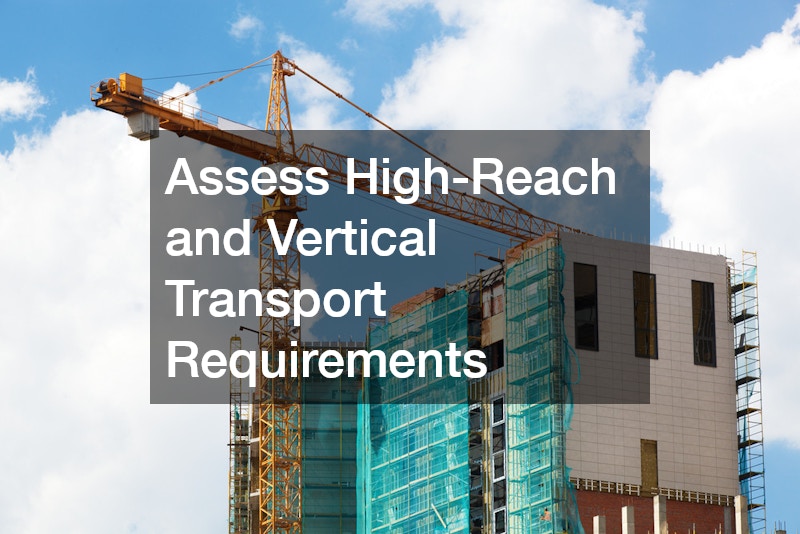
As a project begins to rise vertically, the logistical challenges multiply. Moving workers, tools, and materials dozens or hundreds of feet into the air introduces severe safety risks associated with gravity, wind, and overhead obstructions. Auditing these overhead obstacles, calculating wind factors, and determining maximum lift heights are non-negotiable steps to select the appropriate boom length and machine footprint for your vertical transport needs.
Conducting an overhead hazard audit must be completed long before any lifting equipment is brought onto the site. This audit is a comprehensive physical inspection of the airspace above your project footprint.
Essential Elements of an Overhead Hazard Audit:
-
Power Line Proximity: Identify all overhead electrical lines and establish strict “No Go” zones. OSHA mandates minimum clearance distances, and your machine’s swing radius must physically be locked out from breaching these zones.
-
Natural Obstructions: Note the location of mature, overhanging trees whose branches could entangle a boom or obscure an operator’s line of sight.
-
Structural Encroachments: Be hyper-aware of neighboring rooflines, balconies, or communications towers that could interfere with the swing path of a large boom arm.
Understanding load charts is perhaps the most critical technical skill when selecting high-reach machinery. A load chart is a complex mathematical grid that dictates exactly how much weight a machine can lift at various heights and angles. It is vital to understand that a machine’s lifting capacity decreases dramatically the further the boom extends horizontally away from the base. A machine that can safely lift 10,000 pounds straight up might only be capable of lifting 1,500 pounds when the boom is extended horizontally over a roofline. Failing to strictly interpret the load chart based on your specific lift geometry will result in structural failure or tipping.
Selecting the right high-reach option depends entirely on what you are elevating. If you are exclusively lifting workers and their hand tools to install siding or paint, an articulating boom lift or a stable scissor lift provides the safest platform. However, if you are lifting heavy pallets of bricks or roofing felt to a third-story deck, a telescopic handler (telehandler) with heavy-duty outriggers is required.
For the heaviest vertical lifts—such as setting massive steel trusses, lifting precast concrete panels, or placing large HVAC units on a roof—standard site equipment will not suffice. Utilizing regional heavy-lift fleets becomes necessary. Sourcing appropriate local crane rentals allows project managers to scale their lifting capacity precisely for the specific days they need it, keeping long-term overhead costs remarkably low. You can bring in a massive hydraulic truck machine for a single weekend to set the steel frame, and then demobilize it immediately to free up space on the site.
To ensure these critical lifting phases go smoothly, building long-term vendor relationships is incredibly advantageous. Consistently utilizing reliable local crane services who already know the municipality’s permitting rules, understand the region’s specific street closure requirements, and are familiar with your company’s safety culture drastically reduces the administrative friction and delays typically associated with heavy vertical lifts. These established partners will streamline the process, ensuring the machinery arrives on time, fully permitted, and ready to execute the lift safely.
Secure Specialized Support for Complex or Odd-Sized Loads
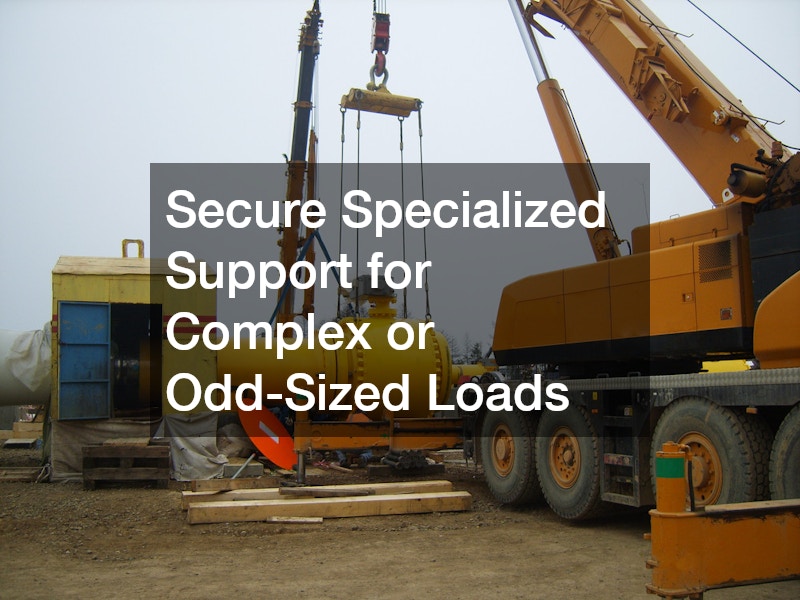
Not all construction materials fit neatly onto a standard wooden pallet. As architectural designs become more complex and building systems become more integrated, contractors frequently find themselves tasked with hoisting large, asymmetrical, and highly delicate components. Planning the exact connection points and securing methods for awkwardly shaped architectural elements before attempting to hoist them is a critical phase of machinery coordination.
Identifying non-standard loads early in the project planning phase is essential. You must look beyond simple weight metrics and consider the physical dimensions and fragility of the load. Moving a compact, incredibly dense bundle of rebar is a very different physical challenge than lifting a massive, lightweight, and fragile pre-fabricated structural panel. Unique challenges arise when lifting industrial HVAC rooftop units, which have off-center compressors that make the unit heavier on one side, or when hoisting massive steel I-beams that require perfect horizontal balance to be set into place smoothly.
Understanding the center of gravity is paramount when dealing with these complex items. An asymmetrical load may fall well under the maximum weight limit of your lifting machinery, but if the center of gravity is miscalculated, the load will violently shift the moment it leaves the ground. This sudden kinetic shock can snap hoisting cables, swing the load into adjacent structures, or cause catastrophic tipping of the machinery itself. You must pinpoint the exact balance point of every non-standard load to ensure it rises perfectly level.
Ensuring secure connections requires specialized hardware and deep expertise. Standard chains or basic straps are often insufficient for complex lifts. It is frequently necessary to secure external expertise by bringing in professional rigging services to supply the correct spreader bars, specialized nylon slings, and high-capacity shackles required to safely balance delicate or awkward materials. These specialists understand how to configure multiple attachment points to distribute the weight evenly, preventing a long, fragile load from bowing or snapping under its own weight during the lift.
Coordinating with heavy-lift experts ensures that all the theoretical math translates safely to the real world. You should never attempt a complex lift based solely on a paper plan. It is highly recommended to prioritize walking the site with representatives from local crane companies to finalize the pick plans in person. During these walkthroughs, the experts will assess the exact ground conditions where the outriggers will be placed, calculate the specific ground bearing pressure limits, and physically verify that there is a clear, unobstructed path from the staging area to the final installation point prior to the designated lift day.
Streamline Delivery Logistics and Initial Site Clearing

The most sophisticated machinery in the world is useless if it cannot physically access your construction site. Delivery logistics and site preparation are frequently overlooked aspects of equipment management, but they are often the source of the most frustrating project delays. Sequencing the arrival of your machines and actively prepping the access roads are critical steps to avoid early project bottlenecks and hazardous site congestion.
Creating a staging and delivery plan requires treating your site like a highly choreographed loading dock. If you schedule multiple massive machines to be delivered on the same morning, you will instantly create a chaotic bottleneck.
Strategies for Staging and Delivery:
-
Staggered Arrival Times: Schedule machine drop-offs in distinct, staggered windows. Give each transport truck ample time to navigate into the site, offload the machinery safely, and exit before the next delivery arrives.
-
Designated Unloading Zones: Clearly mark an obstruction-free zone specifically dedicated to unloading heavy equipment, keeping it entirely separate from material deliveries or active worker zones.
-
Traffic Flow Management: Ensure that large transport trucks do not trap each other on narrow local roads. Plan a clear, one-way loop through the neighborhood and the site if possible.
Managing heavy transport is a logistical hurdle that extends beyond the boundaries of your site. Moving oversized machinery—such as massive tracked earthmovers or towering hydraulic lifting vehicles—through residential neighborhoods or busy commercial districts requires strict legal compliance. You must handle the logistics of legally moving these assets, which involves hiring specialized equipment towing and hauling professionals. These logistics experts handle the intricate details of securing wide-load permits, routing the journey to avoid low bridges or weight-restricted roads, and providing the necessary escort vehicles to ensure the equipment arrives at your site legally and without incident.
Preparing the access routes is the next vital step. An unimproved dirt entrance will rapidly degrade into impassable mud after just a few heavy deliveries, trapping transport trucks and grinding your project to a halt. The site entrance must be heavily stabilized before any major equipment arrives. This involves laying down thick tracking pads made of large, crushed rock to support the immense weight of lowboy trailers and to scrub mud off the tires of vehicles exiting the site, keeping the local municipal roads clean and compliant with environmental regulations.
Executing initial site prep paves the way for a smooth project launch. Before the sophisticated lifting machinery or delicate materials are delivered, the raw land must be tamed. By securing proper excavation services right at the project’s kickoff, you ensure that overgrown brush, dangerous debris, and unstable topsoil are cleared efficiently and comprehensively. This initial, heavy-duty clearing process transforms a chaotic, hazardous plot of land into a safe, heavily compacted, and level staging area perfectly primed for the specialized machines that will follow, setting a tone of organization and safety for the remainder of the build.
Maximizing Efficiency Through Smart Selection
The trajectory of a construction project is often decided long before the first foundation is poured; it is decided during the planning phases when equipment choices are finalized. Navigating the complex requirements of a local build demands a strategic approach to machinery selection. As we have explored, this process requires diligently auditing site constraints, calculating precise material payloads, planning intricate vertical lifts, and streamlining the often-chaotic delivery logistics. Skipping any of these steps inevitably leads to financial loss, damaged property, or compromised site safety.
It is crucial to view the machinery you bring onto a site not just as rental expenses, but as a vital extension of your human workforce. The right equipment does more than just move dirt or lift steel; it fundamentally protects the human crew from severe physical strain and catastrophic injury. It acts as a force multiplier, speeding up the project timeline while simultaneously ensuring a higher quality of installation and precision that manual labor alone cannot achieve. Conversely, forcing the wrong machine to do a job it wasn’t designed for is a gamble that professional contractors simply cannot afford to take.
As you move forward, let this guide serve as a foundational checklist during your next pre-construction phase. Do not wait until you are facing a logistical nightmare on site to evaluate your equipment needs. Proactively analyze your site blueprints, calculate your loads, and anticipate your logistical bottlenecks early. Most importantly, build strong, communicative relationships with the equipment specialists, rental yards, and transport professionals in your region well before the project breaks ground. By combining meticulous site analysis with the expertise of reliable partners, you can ensure that your project is equipped with the exact machinery needed to build safely, efficiently, and profitably.
